Top AI Trends in Retail to Watch in 2026
Introduction
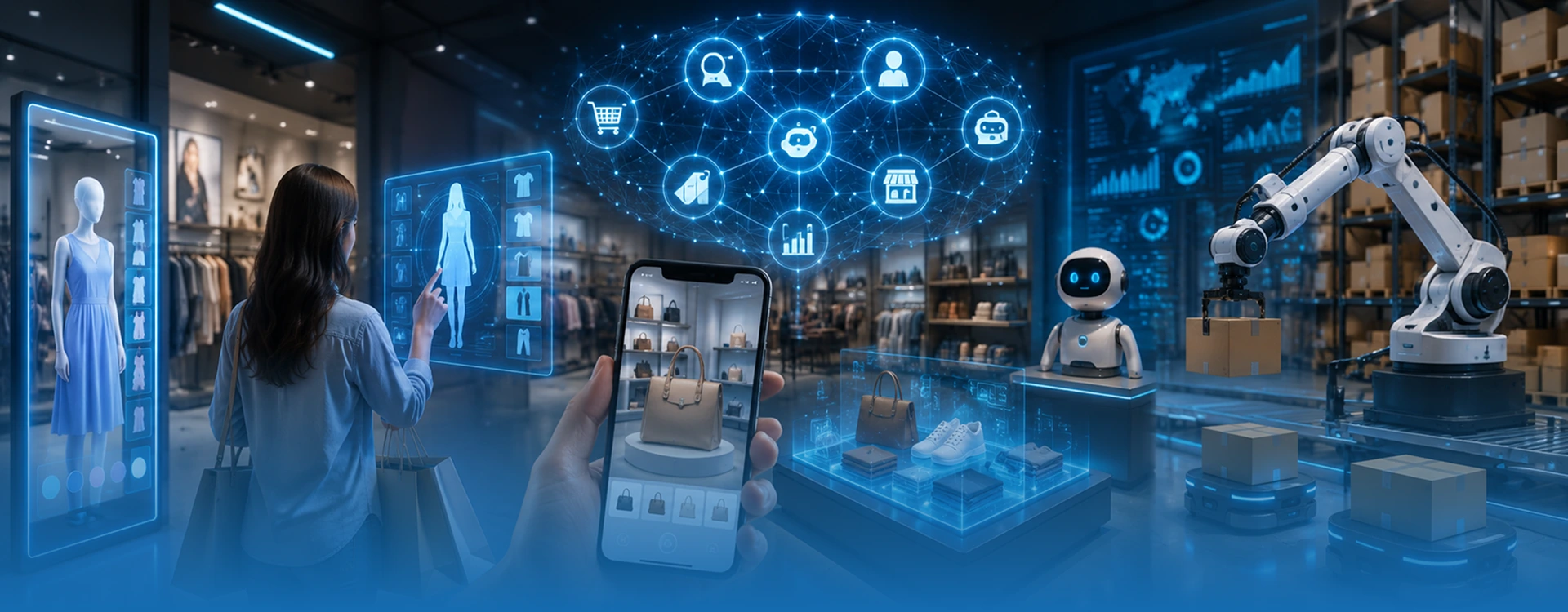
Artificial Intelligence is becoming a core technology across the retail industry. Retail companies are using AI systems to analyze customer data, generate marketing content, detect fraud, support shoppers, and monitor store activity across both online and physical stores.
In this article, we’ll explore the top AI trends shaping the retail industry in 2026, including personalization, generative AI in marketing, demand forecasting, conversational commerce, and smart store technologies.
Hyper-Personalized Shopping Experiences
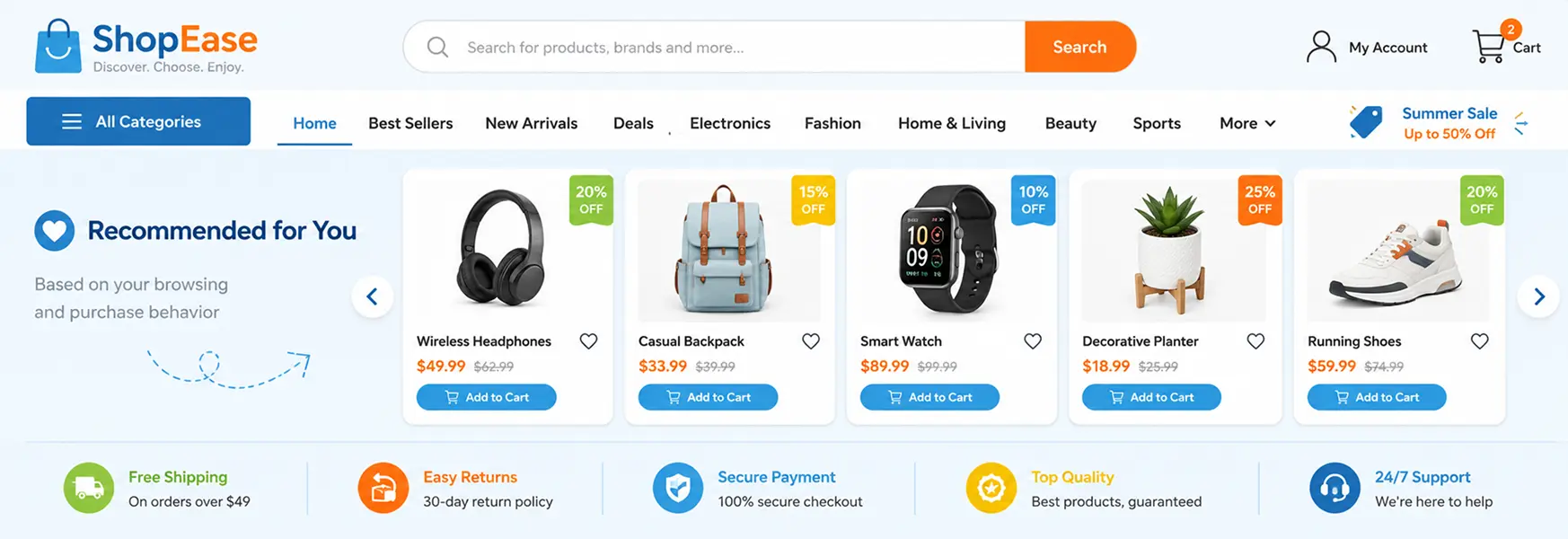
Personalized shopping has moved from being a “nice-to-have” feature to something customers now expect every time they interact with a brand. In today’s retail environment, shoppers don’t want to browse through hundreds of irrelevant products. They want to see items that match their taste, budget, and needs right away. This is where AI-driven personalization plays a key role.
AI systems collect and analyze large amounts of customer data in real time. This includes past purchases, browsing history, time spent on product pages, search queries, location, device type, and even how a user interacts with emails or ads. By connecting all these data points, retailers can build detailed customer profiles and understand what each shopper is likely to buy next.
Based on this analysis, AI engines recommend products that feel highly relevant to the customer. For example, if someone frequently buys fitness gear, the system may highlight new workout equipment, offer discounts on related products, or suggest complementary items like protein supplements or accessories. This makes the shopping experience faster and more enjoyable.
Recent retail data shows that around 71 percent of e-commerce websites now use AIpowered recommendation systems. These systems are no longer limited to large companies. Even mid-sized and growing retailers are adopting them to stay competitive and meet customer expectations.
The impact on revenue is significant. Studies suggest that personalized product recommendations can contribute up to 31 percent of total e-commerce revenue for some businesses. This happens because customers are more likely to purchase when they see products that match their interests, rather than generic listings.
Personalization is used across multiple retail touchpoints, including:
- Online product recommendations on homepages and product pages
- Personalized email campaigns with tailored offers and product suggestions
- Loyalty programs that reward customers based on their preferences and behavior
- Mobile shopping apps that show customized feeds and notifications
In addition, AI can adjust recommendations in real time. For instance, if a customer suddenly starts searching for travel-related items, the system can quickly shift and show luggage, travel accessories, or seasonal deals. This level of responsiveness helps retailers stay relevant at every stage of the customer journey.
Another important benefit is improved customer engagement. When shoppers feel understood, they tend to spend more time on the platform, explore more products, and return for future purchases. Over time, this builds stronger customer relationships and increases lifetime value.
Hyper-personalization also helps reduce decision fatigue. Instead of overwhelming users with too many choices, it narrows down options and guides them toward products they are more likely to buy. This creates a smoother and more satisfying shopping experience.
In simple terms, AI-powered personalization helps retailers show the right product to the right customer at the right time. As technology continues to improve, this level of personalization will only become more accurate and more important for retail success.
Generative AI in Retail Marketing and Product Content
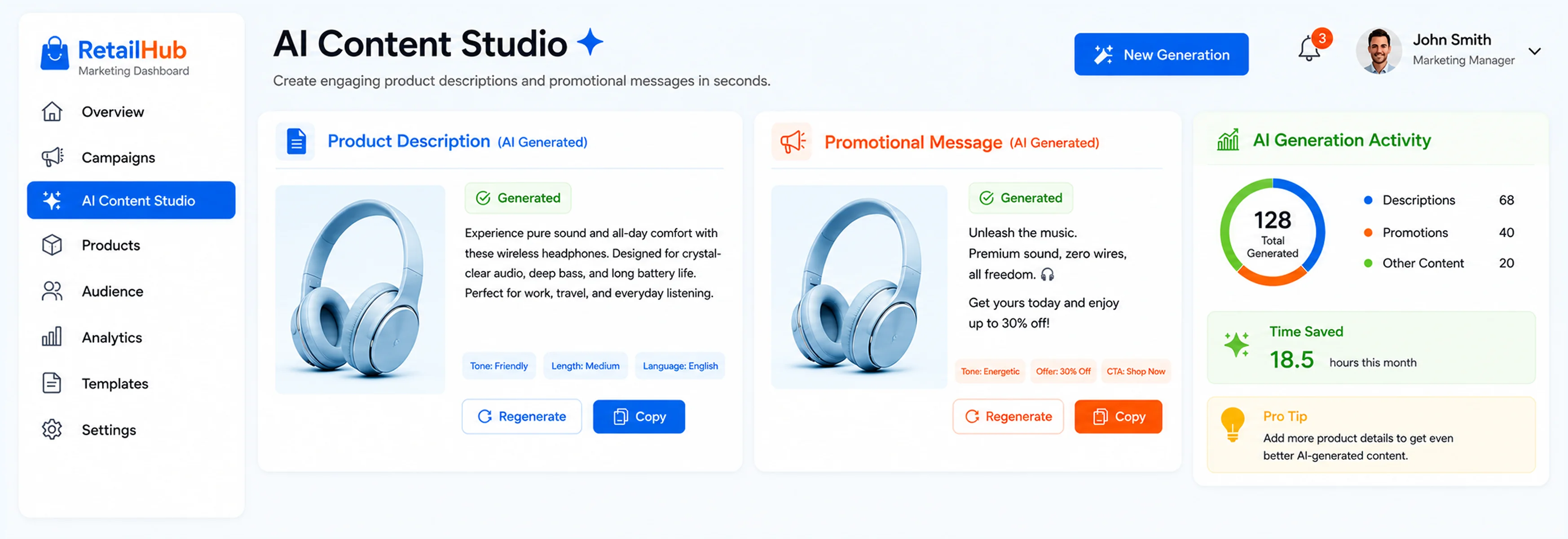
Generative AI is quickly becoming a key part of how retail marketing teams create and manage content. Instead of writing everything manually, teams now use AI tools to produce product descriptions, ad copy, email campaigns, and social media posts at scale.
Retail businesses often deal with large product catalogs that include hundreds or even thousands of items. Writing unique and engaging descriptions for each product can take a lot of time. Generative AI helps solve this by creating high-quality content within seconds, while still keeping the tone and messaging consistent across the brand.
These systems can generate:
- Product descriptions based on features and specifications
- Marketing messages tailored to different audiences
- Advertising copy for search and social media campaigns
- Social media captions and promotional posts
This allows marketing teams to focus more on strategy and creativity instead of repetitive writing tasks.
Adoption of generative AI in retail has grown rapidly. Around 73 percent of retail executives have already started implementing generative AI in some form. At the same time, about 62 percent of retailers are actively deploying or testing these tools across different parts of their business.
These numbers show that generative AI is no longer in the early testing stage. It is now being used in real business scenarios such as improving product pages, creating marketing campaigns, and even supporting personalized shopping experiences.
One of the biggest advantages of generative AI is speed. Retailers can launch campaigns faster, update product listings more often, and respond quickly to seasonal trends or market changes. For example, during a festive sale or special promotion, AI can generate multiple variations of ad copy in minutes, helping teams test what works best.
Another important benefit is consistency. AI tools can follow brand guidelines and maintain a uniform tone across all content. This is especially useful for companies that sell across multiple channels like websites, mobile apps, marketplaces, and social media platforms.
Generative AI also supports A/B testing at scale. Marketing teams can create multiple versions of the same message and test them with different customer segments. Over time, this helps identify which type of content drives more clicks, engagement, and conversions.
The impact on sales is also noticeable. Experiments in online retail platforms show that generative AI can increase product sales by up to 16 percent. This improvement often comes from better product descriptions, clearer messaging, and more engaging content that helps customers make purchase decisions faster.
In addition, AI-generated content can be personalized. For example, different users may see slightly different product descriptions or promotional messages based on their interests, browsing behavior, or past purchases. This adds another layer of relevance to the shopping experience.
Overall, generative AI is helping retail marketing teams move faster, test more ideas, and manage large volumes of content without increasing workload. As more retailers adopt these tools, content creation is becoming more data-driven, flexible, and closely aligned with customer preferences.
AI Demand Forecasting and Inventory Planning
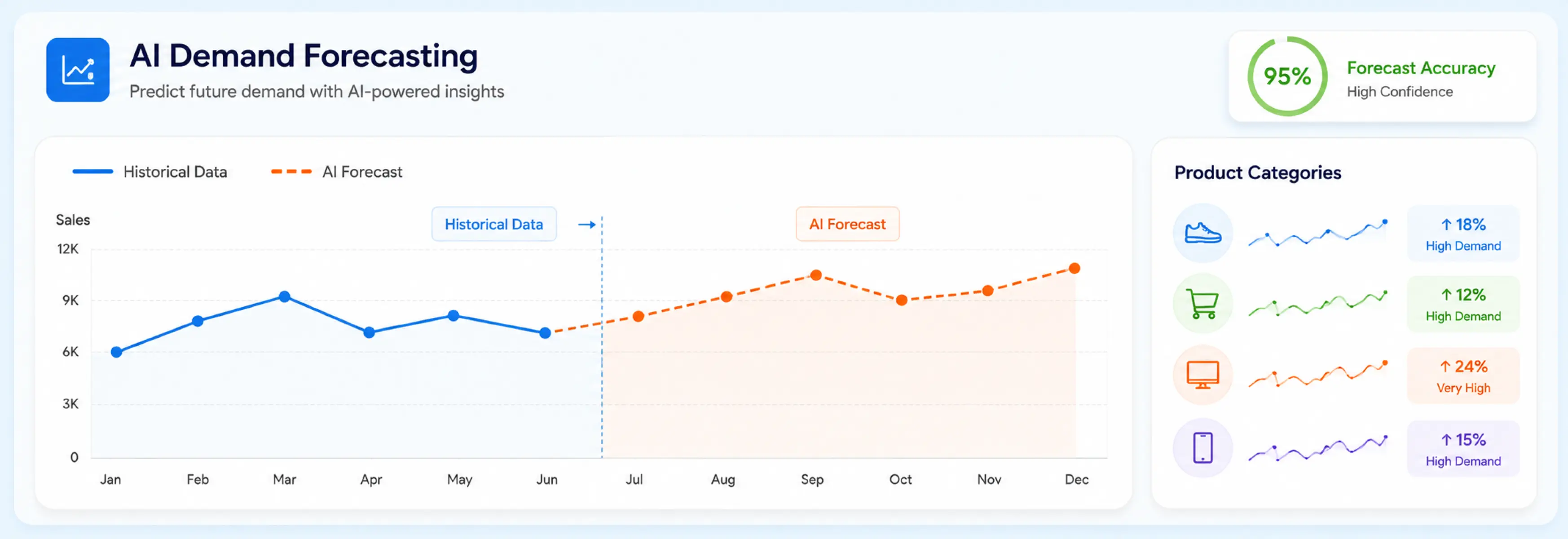
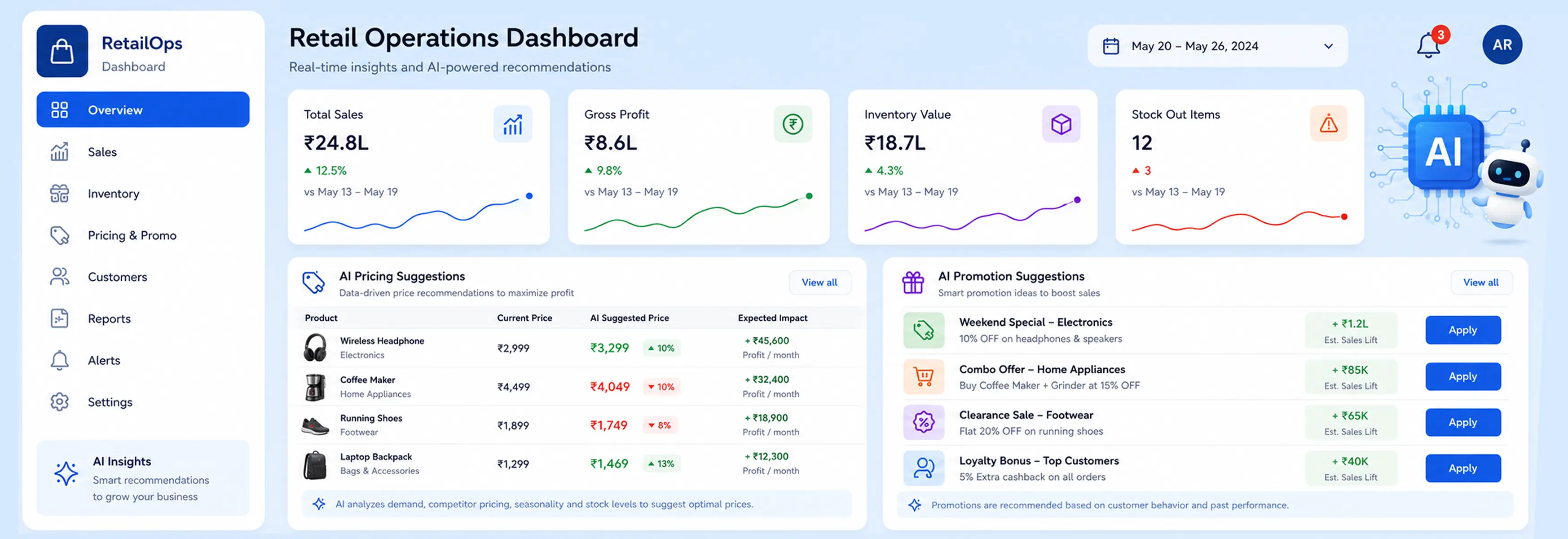
Inventory planning has always been one of the toughest parts of running a retail business. Retailers need to strike the right balance. Too much stock leads to high storage costs and unsold products, while too little stock can result in missed sales and unhappy customers.
AI is helping retailers solve this problem by making demand forecasting more accurate and data-driven.
AI forecasting tools analyze a wide range of data points, including:
- Historical sales data
- Seasonal trends and holiday patterns
- Customer purchasing behavior
- Regional demand differences
- External factors like promotions or market trends
By processing all this data together, AI can predict future demand with much greater accuracy than traditional methods.
Today, around 68% of large retailers are already using AI systems for inventory management and supply chain planning. This shows how important these tools have become in day-to-day retail operations.
One of the biggest advantages of AI forecasting is its ability to adapt quickly. For example, if a product suddenly becomes popular due to a trend or social media buzz, AI systems can detect the spike early and adjust demand predictions. This helps retailers restock faster and avoid losing sales.
Some advanced AI forecasting systems can achieve accuracy levels close to 95%. This level of precision allows retailers to make better decisions about how much stock to keep and when to reorder products.
The impact on costs is also significant. Businesses using AI for inventory planning have reported reductions in inventory costs by up to 40 percent. This happens because companies can avoid overstocking slow-moving items and reduce waste, especially in categories like fashion or perishable goods.
AI also improves supplier planning. Retailers can use demand forecasts to:
- Plan purchase orders more accurately
- Negotiate better terms with suppliers
- Reduce emergency restocking costs
- Improve warehouse space usage
In addition, AI can automate inventory decisions. For example, it can trigger automatic reorders when stock levels fall below a certain threshold or suggest transferring products between store locations based on demand differences.
Another key benefit is better product availability. When retailers have the right products in the right place at the right time, customers are more likely to complete their purchases. This directly improves customer satisfaction and builds trust in the brand.
AI forecasting is especially useful for businesses that operate across multiple channels, such as online stores, physical outlets, and marketplaces. It ensures that inventory is distributed efficiently across all channels, reducing both shortages and excess stock.
In simple terms, AI helps retailers move from guesswork to accurate planning. With better demand predictions and smarter inventory decisions, businesses can reduce costs, improve availability, and respond faster to changing customer needs.
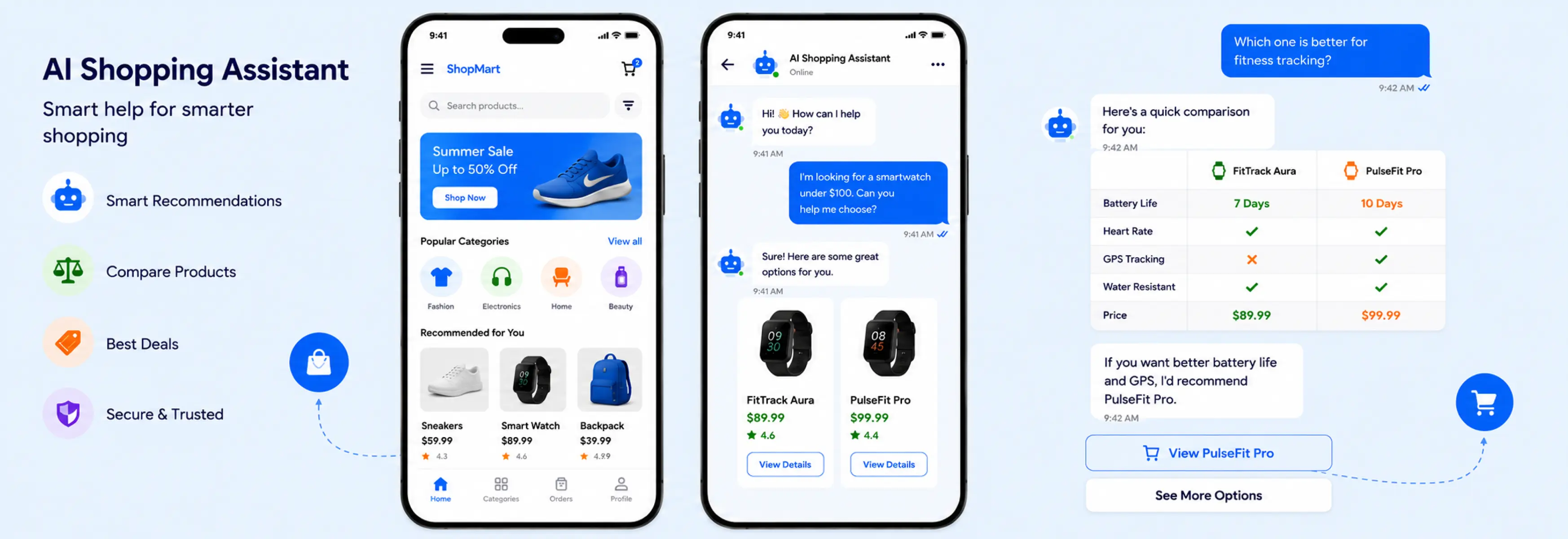
Conversational Commerce and AI Shopping Assistants
Visual Search and Image Recognition in Retail
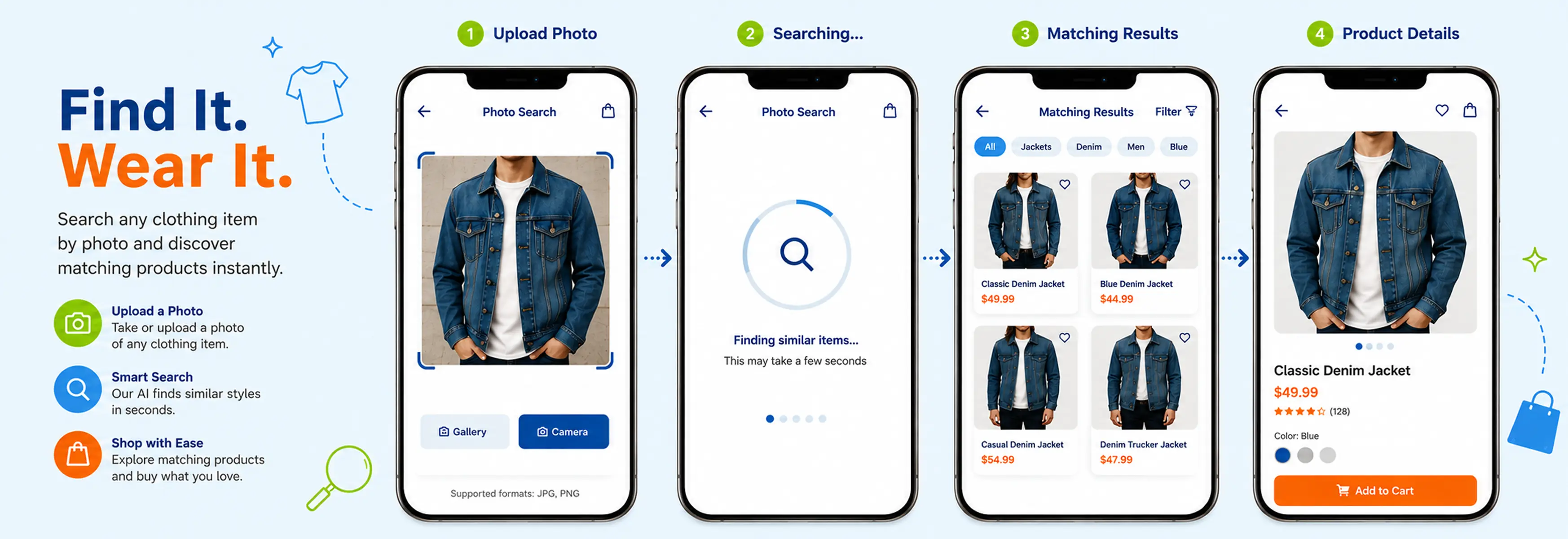
Visual search helps customers find products faster using images. Instead of typing keywords and scrolling through results, shoppers can now upload an image and instantly find similar items. This makes the search process faster, more natural, and closer to how people actually shop in real life.
For example, if a customer sees a dress, sofa, or pair of shoes they like, they can simply take a photo or upload a screenshot. AI-powered systems then analyze the image and show visually similar products available in the store. This removes the need to guess product names or use the right search terms.
At the core of this technology is image recognition. AI models are trained to identify patterns such as shapes, colors, textures, and product features. Based on this analysis, the system matches the uploaded image with relevant items from the retailer’s catalog.
Customers can use visual search to:
- Find similar products from a photo or screenshot
- Discover items seen on social media or in real life
- Explore variations like different colors or styles
- Quickly locate products without typing descriptions
This creates a smoother and more intuitive shopping experience, especially for categories like fashion, home decor, and accessories where visuals matter more than text.
Retailers are also using image recognition internally to better manage their product catalogs. AI can automatically tag and categorize products based on visual attributes. For example, it can identify whether a shirt is “striped,” “formal,” or “casual” without manual input. This improves product organization and makes search results more accurate.
Another advantage is better product discovery. Traditional keyword search depends on how well a product is described. If the description is incomplete or uses different terms than what the customer searches for, the product may not appear. Visual search removes this limitation by focusing on how the product actually looks.
Visual AI also supports features like:
- “Shop the look” experiences where users can buy items from a full outfit or room setup
- Automatic tagging of images for faster catalog updates
- Duplicate product detection to avoid listing errors
- Enhanced filtering based on visual similarity
As e-commerce continues to grow, visual search is becoming more common across platforms. Many retailers are integrating it into mobile apps, where users can directly use their phone cameras to search for products in real-time.
This technology is especially useful for mobile-first users, who often prefer quick and simple interactions over typing detailed queries.
In addition, visual search connects well with social commerce. Customers often discover products through images on social media. With visual AI, they can move from inspiration to purchase in just a few steps.
In simple terms, visual search makes online shopping more natural by letting customers search the way they see. As AI models continue to improve, image recognition will play a bigger role in helping customers find exactly what they are looking for, faster and with less effort.
AI for Fraud Detection and Retail Security
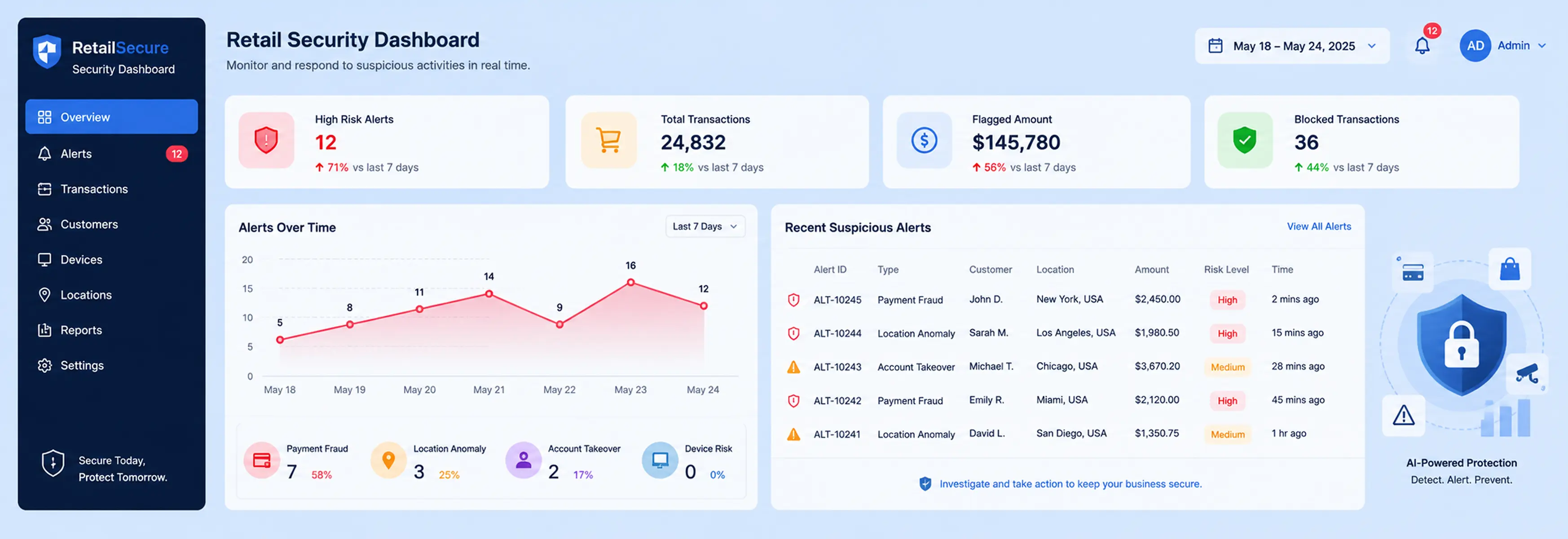
Retail businesses handle a massive number of transactions every day, both online and in physical stores. With this scale comes risk. Fraudulent activities like fake returns, stolen payment methods, and account takeovers continue to increase, making security a top priority for retailers.
AI is helping retailers detect and prevent fraud by analyzing transaction data in real time. Instead of relying only on fixed rules, machine learning systems learn from past data and identify patterns that may indicate suspicious behavior.
These systems monitor factors such as:
- Unusual purchase amounts or frequency
- Sudden changes in customer behavior
- Mismatched billing and shipping details
- Multiple returns from the same account
- Transactions from different locations in a short time
By combining these signals, AI can flag potentially fraudulent activity much earlier than traditional methods.
Retail fraud is a serious financial challenge. Industry reports estimate that fraudulent retail returns alone cost businesses around $76.5 billion in 2025. This highlights how important it is for retailers to have strong detection systems in place.
One of the biggest advantages of AI in fraud detection is speed. AI systems can analyze thousands of transactions instantly and identify risks in real time. This allows retailers to take immediate action, such as blocking a transaction, requesting additional verification, or flagging an account for review.
Another key benefit is accuracy. Traditional rule-based systems can generate too many false alerts, which wastes time and affects genuine customers. AI improves this by learning what normal behavior looks like and reducing unnecessary flags, while still catching real threats.
AI also adapts over time. As fraud tactics evolve, machine learning models update themselves based on new data. This helps retailers stay protected against emerging threats without constantly rewriting rules.
In addition to transaction monitoring, AI supports other security areas such as:
- Detecting fake or abusive return requests
- Identifying bot activity on e-commerce platforms
- Preventing account takeovers
- Monitoring unusual login behavior
These tools not only reduce financial losses but also protect customer trust. When shoppers feel that their data and transactions are secure, they are more likely to continue buying from the same brand.
At the same time, AI helps maintain a smooth customer experience. Security checks happen in the background, so genuine customers can complete their purchases without unnecessary delays.
In simple terms, AI acts as a smart security layer that constantly monitors retail activity. It helps businesses detect risks early, reduce fraud-related losses, and create a safer shopping environment for customers.
Autonomous AI Agents in Retail Operations
AI Demand Forecasting and Inventory Planning
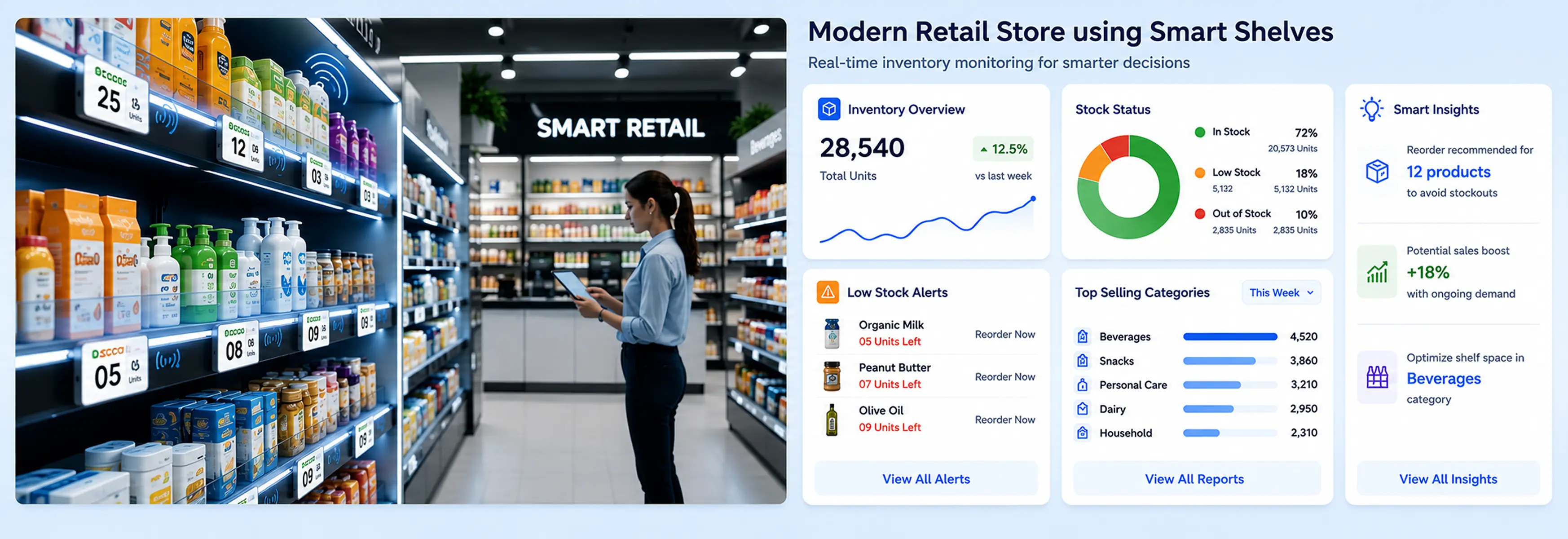
Walk into a modern retail store today, and there’s a good chance AI is working quietly in the background. Physical stores are becoming smarter with the help of computer vision, which uses cameras and sensors to understand what’s happening in real time.
Instead of relying only on manual checks, retailers can now track store activity automatically. Computer vision systems analyze video feeds to understand customer behavior, product movement, and shelf conditions without interrupting the shopping experience.
These systems can monitor things like:
- Which areas of the store get the most foot traffic
- How long customers spend in specific sections
- Which products are picked up but not purchased
- When shelves are running low or empty
One of the most valuable use cases is shelf monitoring. For example, Walmart uses computer vision AI to detect up to 95% of out-of-stock shelf situations in real-time, allowing faster restocking and better product availability.
Some common applications in smart stores include:
- Smart shelves that detect low stock and send alerts
- Automated checkout systems that reduce or remove waiting lines
- Shopper movement tracking to understand in-store behavior
- Shelf monitoring to ensure correct product placement
For example, if a popular product runs out during peak hours, the system can immediately notify staff. This reduces the time shelves stay empty and helps maintain consistent product availability.
Computer vision also helps improve store layout. By analyzing how customers move through the store, retailers can identify high-traffic zones and place important products in those areas. This increases visibility and can lead to higher sales.
Another benefit is better product placement. AI can track whether items are displayed correctly according to planograms. If products are misplaced or not aligned with the intended layout, the system can flag the issue for correction.
Automated checkout is another major advancement. Customers can pick up items and leave without standing in line, while AI systems handle billing in the background. This creates a faster and more convenient shopping experience.
In addition, these systems provide useful data for decision-making. Retailers can understand what’s working in the store and what needs improvement, based on actual customer behavior rather than assumptions.
In simple terms, computer vision turns physical stores into data-driven environments. It helps retailers keep shelves stocked, improve store design, and offer a smoother in-store experience for customers.
Conclusion
Artificial Intelligence is becoming a foundational technology across the retail industry. Retail companies are using AI tools to personalize shopping experiences, support marketing teams, manage inventory, and monitor store activity.
As AI technologies continue to evolve, retailers that invest in intelligent systems will be better positioned to understand customer behavior and adapt to new shopping patterns.
At Brevity Technology Solutions, we help businesses explore AI technologies and digital platforms that support modern retail environments.
If your organization is planning AI adoption for retail platforms, customer data systems, or digital commerce solutions, book a free consultation call to explore the best way to implement AI in your retail systems.
Related Post



-
F
-
A
-
Q
AI in retail refers to the use of artificial intelligence technologies to analyze customer data, support marketing, manage inventory, detect fraud, and improve shopping experiences across online and physical stores.
Retailers are using AI for:
- Personalized Product Recommendations
- Demand Forecasting
- Chatbots and Virtual Assistants
- Visual Search
- Fraud Detection
- In-Store Analytics using Computer Vision
AI helps retailers:
- understand customer preferences
- improve product discovery
- manage stock levels
- reduce fraud risks
- support faster customer service
These benefits help businesses improve customer satisfaction and make better data-based decisions.
Yes. Many AI tools are available through cloud platforms and software services, making them accessible for small and mid-size retail businesses without large upfront investment.
No. AI is used in both online and physical retail.
Online, it supports personalization and product recommendations. In physical stores, it is used for smart shelves, automated checkout, and store analytics.
Enterprise retailers can integrate AI by connecting it with existing systems such as ERP, CRM, and e-commerce platforms through APIs and data pipelines.
AI models use data from these systems to generate insights for areas like customer behavior, inventory planning, and sales trends. Many organizations start with a pilot use case, such as demand forecasting or personalization, and then expand across departments once the integration is stable.
AI systems rely on multiple sources, including:
- customer purchase history
- website and app behavior
- inventory and supply chain data
- transaction records
- in-store sensor or camera data
Enterprises need clean, well-organized data to get reliable results. Many companies invest in data platforms or data lakes to centralize information before applying AI models.
AI adoption in retail is expected to continue growing as more businesses invest in data and digital systems. Technologies such as generative AI, visual search, and AI-powered assistants will continue to shape how customers shop and how retailers operate.
Some common challenges include:
- data silos across different departments
- integration with legacy systems
- data quality and consistency issues
- change management and team adoption
- privacy and security concerns
Getting started with AI begins with identifying the right use case based on your business goals, such as personalization, inventory planning, or customer analytics.
Many retailers start with a focused approach, test results, and then expand AI across other areas.
If you’re unsure where to begin, a consultation can help you identify the most relevant AI opportunities for your business.
Want to Scale
Your Business? Let’s Meet & Discuss!

CANADA
30 Eglinton Ave W Mississauga, Ontario L5R 3E7
Get a Quote Now
Let's delve into a thorough understanding of your challenges and explore potential solutions together